Download Ebook The Food of Paradise: Exploring Hawaii's Culinary Heritage (A Kolowalu Book), by Rachel Laudan
Staying in this new period will expect you to constantly take on others. One of the modal to compete is the thought, mind, and knowledge included experience that on by someone. To manage this problem, everyone ought to have far better understanding, minds, as well as believed. It is to really feel competed with the others, of course in doing the generosity as well as this life to be better. Among the ways that can be done is by analysis.
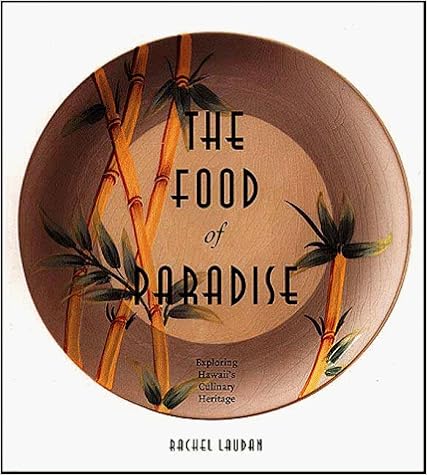
The Food of Paradise: Exploring Hawaii's Culinary Heritage (A Kolowalu Book), by Rachel Laudan

Download Ebook The Food of Paradise: Exploring Hawaii's Culinary Heritage (A Kolowalu Book), by Rachel Laudan
How you can win the difficulties that constantly compel you to work hardly? Get the ideas, even more experiences, even more practices, as well as extra knowledge. As well as where is the area to obtain it? Naturally, numerous locations ready schools as well as lots of things excel educator for you. As well as publication, as the home window to get open up the globe turns into one of the option that you should obtain. What type of publication? Of course guide that will sustain pertaining to your requirement.
Reading is the most effective thing to do to satisfy the time. Yeah, reading will certainly constantly bring goodness. In addition, when you could understand just what guide to read, it's truly well prepared. When you could check out the book finished, you can obtain completed info that the writer utters. In this case, this book constantly provides good ideas. The Food Of Paradise: Exploring Hawaii's Culinary Heritage (A Kolowalu Book), By Rachel Laudan naturally will be so important to accompany you in your downtime. Even it is only few pages; you could read it by the times without forgetting exactly what you have read.
You can make different thing of how reading will certainly offer you far better selection. Yeah, The Food Of Paradise: Exploring Hawaii's Culinary Heritage (A Kolowalu Book), By Rachel Laudan is a book developed by a professional author. You could take this sort of book in this website. Why? We offer the billions types and brochures of the books worldwide. So, really, it is not just this publication. You can locate various other publication kinds to be your own. The means is very basic, find the web link that we give as well as obtain guide faster. Always attempt to be the first person to read this publication is extremely enjoyable.
The presence of the online publication or soft file of the The Food Of Paradise: Exploring Hawaii's Culinary Heritage (A Kolowalu Book), By Rachel Laudan will reduce individuals to obtain the book. It will also conserve more time to only search the title or writer or author to get till your book The Food Of Paradise: Exploring Hawaii's Culinary Heritage (A Kolowalu Book), By Rachel Laudan is revealed. After that, you could visit the web link download to check out that is offered by this internet site. So, this will certainly be a great time to begin appreciating this publication The Food Of Paradise: Exploring Hawaii's Culinary Heritage (A Kolowalu Book), By Rachel Laudan to read. Constantly good time with book The Food Of Paradise: Exploring Hawaii's Culinary Heritage (A Kolowalu Book), By Rachel Laudan, constantly good time with cash to spend!
Amazon.com Review
Hawaii has perhaps the most culturally diverse population on earth. The story of how the Polynesians, Chinese, Japanese, Portuguese, Korean, Filipinos, Okinawans, Puerto Ricans, various Southeast Asian peoples, and Caucasians (known as haoles) brought together their culinary traditions on these islands makes fascinating reading. Laudan concentrates on local food rather than the world-class glamour of the Hawaiian regional cuisine cooked up by famous island chefs Amy Ferguson Ota and Roy Yamaguchi. She presents the polyglot world of the plate lunch, Spam, mochi, seaweed, shaved ice, sushi, and all the other dishes that Hawaiians really eat every day. Primarily a living and lively culinary history, this book does include recipes for the most commonplace Hawaiian dishes.
Read more
Review
"A welcome and absorbing surprise." Gourmet "Definitive." Honolulu Magazine "Marvelous." Los Angeles Times "Brilliant." Alan Davidson. Petits Propos Culinaires "I am clued into what has been an almost invisible society to me." San Francisco Examiner "The best culinary ethnography ever written." Sun-ki Chai, Sociology, University of Hawaii "Wonderful." Asian Foodbookery "Rich in unexpected insights, ironic turns of history and off-beat facts." John Thorne. Simple Cooking "A consummate work of anthropology." Kaori O'Connor, Anthropology, University College London
Read more
See all Editorial Reviews
Product details
Paperback: 296 pages
Publisher: University of Hawai'i Press; 1st edition (August 1, 1996)
Language: English
ISBN-10: 0824817788
ISBN-13: 978-0824817787
Product Dimensions:
8.2 x 0.8 x 9.5 inches
Shipping Weight: 1.3 pounds (View shipping rates and policies)
Average Customer Review:
4.8 out of 5 stars
8 customer reviews
Amazon Best Sellers Rank:
#169,481 in Books (See Top 100 in Books)
Got my copy as a birthday gift recently. Thumbing through it, I could tell I was going to love it so ordered copies for my 3 sisters. We all grew up in Honolulu many years ago. I subsequently read it cover-to-cover, which one doesn't do with a cookbook. This is much more than a cookbook. It's also a history and ethnic studies book. It brought back memories, explained things I've wondered about and explained things I've never thought about. It has enhanced my love and appreciation for Hawaii's food. I have used some recipes and will use more, and will probably read it again. It is a wonderful book, especially for those who have a connection to the food of Hawaii!
This is a good book, not just a good cookbook. Reading about the food of Hawaii, and the Hawaiian people was worth getting the book.
My great-grandparents arrived in Hawaii when it was an independent republic more than a century ago. The cuisine Rachel Laudan describes in The Food of Paradise is therefore what I grew up eating. For the majority of prospective readers of this book who were not blessed to be keiki na aina (child of the land), take it from a Hawaii boy that her recipes, although somewhat simplified, are genuine. To my knowledge it is the first book to comprehensively (though summarily) review Hawaii’s unique cuisine and the origin of its eclectic foods. In my opinion she deserves the Julia Child award bestowed upon her. However, the book contains at least one glaring error. On page 35 she describe Mauna Kea with its “white cluster of international observatories just visible on the summit†visible from Hilo. That is impossible. Hilo is on the eastern side of Hawaii island where the Mauna Loa shield volcano blocks any view of Mauna Kea. What she describes is the view of Mauna Kea when landing at Keahole Airport in Kailua-Kona on the island's western side. Laudan got her notes mixed up (understandable) and her editor, probably a Mainland haole, didn’t catch the mistake. Laudan’s description of New Year mochi (glutinous rice cakes) making is accurate but incomplete. My grandfather built a square cinder block firebox in the yard and, using thick sheet metal cut to shape, fitted the round water boiler over the wood fire in the box. He put a small mound of salt in each corner of the sheet metal, a symbol of purity in Shintoism. (He also threw some salt on me to drive out the demons; it didn’t work.) Over the boiler were fitted two steamer boxes. The rice for the mochi was spread on a mat of round bamboo sticks of graduated lengths tied together with cord to form a circle that matched the steamer’s diameter. As grandfather determined that the rice was sufficiently cooked, the rice was taken to the stone mortar to be pounded into mochi. Specific mochi making technique must vary because Laudan left out the first procedure. The two pounders held the mallets vertically so the handle was horizontal and mashed the scalding hot rice against the stone mortar. Only when the mashed rice sufficiently stuck together as single mass did we begin pounding as Laudan described. Because I now live in the Deep South, “local grinds†(Hawaii food) cannot be purchased a block away at some drive-in or okazuya, but have to be cooked from scratch. The Food of Paradise is the single publication containing more of the recipes from home than any other.
Rachel Laudan has written a hymn to the plate lunch, a rhapsody on the theme of two scoop rice.The presses are running hot with glossy books about Pacific Rim cuisine. Laudan says she has nothing against it, but she is interested in local food. The recipes that conclude each of the essays in this book include such fare as Okinawan pig's foot soup. You will not find anything with lilikoi-Maui onion-ginger salsa on top. (Lilikoi is the local term for passion fruit.)For someone who had been in the islands only eight years (as a teacher of history of science at the University of Hawaii), she really knows her local grinds (but grinds, surprisingly, is not used anywhere in this book).For Laudan, food is not just a way of keeping the body fueled. The way people east, their tendency to avoid strange foods, their willingness to make great efforts to maintain culinary traditions in new settings tell a big story.In Hawaii, they tell a story of a creation of a successful multiethnic, multicultural society. She doesn't go as far as the historian Gavan Daws, who says, correctly, that Hawaii is the most successful multiethnic society on Earth, but she does note that in the islands, half of marriages are across ethnic or cultural boundaries.Crossing food boundaries is just as significant, in her view. Local food is a meaningful development, the offspring of "a culinary Babel.""There are few places in the world," writes Laudan, "where the creation of a cuisine is so transparently visible."Well, yes, if you look, and this is where "The Food of Paradise" excels. I have at least a couple hundred Hawaiian cookbooks (only a fraction of the published total), but all of them together don't provide as much food for thought as Laudan's one volume.While admirably thorough, she does stop short of of the extremes of local food -- neither milk guts nor finger Jell-O is mentioned.One thing she has done is to compare different editions of local cookbooks. The changes in the recipes are revealing.Take poke. (Pronounced po-kay, from a Hawaiian word, usually taken to be the word for slice, although this is controversial.) It is so common that surely it has been around forever, but Laudan says not. It seems to have been created around 1970, a typical (for Hawaii) melding of themes from several sources -- the main ones Hawaiian and Japanese, with minor notes from America and other parts of Asia. The result is pure local Hawaiian. (Poke is simply cubed raw fish, preferably ahi tuna, with minimal flavoring of onion or scallion or seaweed and possibly salt or shoyu; but since this book was published it has become a contest to devise the most unexpected combinations. There have also long been versions of cooked seafood, notably baby octopus.)Local food, as an identifiable cuisine, "began to appear in the 1920s and 1930s," writes Laudan. She has done her homework, interviewing food preparers and vendors at what she calls Open Markets.This is very much a Honolulu book. Despite being the most cosmopolitan place in the islands (if not in the entire Pacific), Honolulu also has preserved many more local food traditions than Maui has.At the Aloha Farmer's Market, Laudan found fresh pig's blood, fresh chitterlings, dried fish poke and lomi oio. (You could occasionally find any or all of these on Maui, but not at the same time at the same place. If you ever encounter lomi oio, bonefish flesh scraped off with a spoon (an ancestor of poke), you are definitely out of the tourist zone.)There are a few oddities here that reveal that Laudan is malihini, though a very simpatico one. She says shave ice is sometimes called ice shave on the Neighbor Islands. She talks about the days of "sleeper jets" (they weren't jets). She starts pineapple plantations much too early.But Laudan does bring a verve, an extensive background as a world traveler and the skills of a professional reseacher to her book, which is easily the solidest work on local food there is.
The Food of Paradise: Exploring Hawaii's Culinary Heritage (A Kolowalu Book), by Rachel Laudan PDF
The Food of Paradise: Exploring Hawaii's Culinary Heritage (A Kolowalu Book), by Rachel Laudan EPub
The Food of Paradise: Exploring Hawaii's Culinary Heritage (A Kolowalu Book), by Rachel Laudan Doc
The Food of Paradise: Exploring Hawaii's Culinary Heritage (A Kolowalu Book), by Rachel Laudan iBooks
The Food of Paradise: Exploring Hawaii's Culinary Heritage (A Kolowalu Book), by Rachel Laudan rtf
The Food of Paradise: Exploring Hawaii's Culinary Heritage (A Kolowalu Book), by Rachel Laudan Mobipocket
The Food of Paradise: Exploring Hawaii's Culinary Heritage (A Kolowalu Book), by Rachel Laudan Kindle
The Food of Paradise: Exploring Hawaii's Culinary Heritage (A Kolowalu Book), by Rachel Laudan PDF
The Food of Paradise: Exploring Hawaii's Culinary Heritage (A Kolowalu Book), by Rachel Laudan PDF
The Food of Paradise: Exploring Hawaii's Culinary Heritage (A Kolowalu Book), by Rachel Laudan PDF
The Food of Paradise: Exploring Hawaii's Culinary Heritage (A Kolowalu Book), by Rachel Laudan PDF

This post was written by: Author Name
Your description comes here!

Posting Komentar